

FBI reports $262 million in losses from account takeover fraud
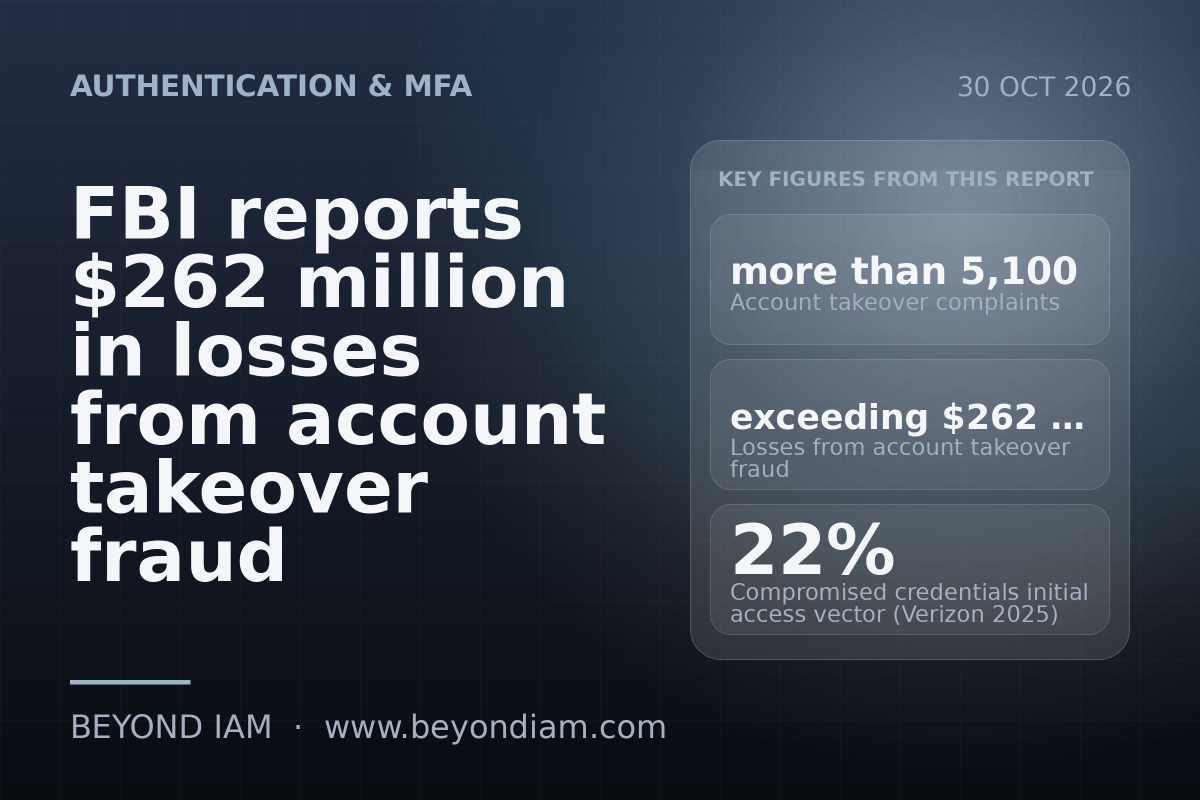
Key figures
| Account takeover complaints | more than 5,100 |
|---|---|
| Losses from account takeover fraud | exceeding $262 million |
| Compromised credentials initial access vector (Verizon 2025) | 22% |
| Compromised Dropbox accounts | approximately 5,000 |
| Dropbox accounts where files were viewed or downloaded | approximately 1,500 |
Timeline
- FBI reports more than 5,100 account takeover complaints filed since this date.
- Approximately 5,000 Dropbox accounts compromised via Lenovo email verification flaw.
- GitLab patched critical flaws in its identity layer.
The FBI reported that more than 5,100 account takeover (ATO) complaints resulting in losses exceeding $262 million were filed since January 2025 [1][4].
These losses stem from attackers gaining unauthorized access to financial, payroll, or health savings accounts to steal money or sensitive information [4].
FBI reports surge in high-value fraud
According to the FBI, cyber criminals frequently drive these takeovers by impersonating bank support staff [1][4]. Using social engineering via texts, calls, and emails, or through fraudulent websites, attackers trick victims into revealing passwords and one-time codes [4]. The FBI Internet Crime Complaint Center (IC3) notes that these schemes target individuals, businesses, and organizations of varied sizes across multiple sectors [4].
Once attackers gain control, they typically wire funds to criminal-controlled accounts, often linked to cryptocurrency wallets to make the money difficult to trace and recover [4]. In nearly all social engineering cases, the attackers change the account password to lock the legitimate owner out [4]. For platforms holding balances or prizes—ranging from retail loyalty schemes to sweepstakes services like americanluck.com—the risk of fast cash-out is particularly acute once an account falls [1].
Mechanics of credential stuffing and session theft
Attackers rarely rely on guessing passwords, instead buying or harvesting valid credentials and sessions in bulk to test them at scale [1]. Verizon research from 2025 found that compromised credentials were the initial access vector in 22% of breaches [1].
Credential stuffing—the automated injection of stolen username and password pairs—remains a primary volume engine for these attacks [1]. The same Verizon data shows that credential stuffing accounted for a median of 19% of all daily single sign-on (SSO) authentication attempts, peaking at 44% on a single day [1].
Beyond passwords, infostealer malware has become a major source of authenticated session cookies [1]. Because these stolen cookies allow an attacker to bypass the login page and MFA prompts entirely, password resets alone are often insufficient to close a security incident [1]. MITRE tracks this technique as Steal Web Session Cookie (T1539), highlighting that detection must cover the entire session rather than just the initial authentication event [1].
Vulnerabilities in federated identity and linked accounts
Flaws in how identity providers (IdP) integrate with other services have enabled large-scale takeovers without the need for passwords. In August 2026, approximately 5,000 Dropbox accounts were compromised due to a flaw in Lenovo's email verification process [7].
Attackers registered Lenovo IDs using other people's email addresses and used those IDs to log into associated Dropbox accounts [7]. "About 5,000 Dropbox accounts were compromised by the hackers, who accessed files on less than a third of them," said Tim Rathschmidt, a Dropbox spokesperson [7]. This affected accounts linked to Lenovo ID that lacked Dropbox's own MFA [7]. Reports indicate that files were viewed or downloaded from approximately 1,500 accounts [7].
GitLab also patched critical flaws in its identity layer on October 21, 2026 [2]. CVE-2026-15723 (CVSS 8.2) allows an authenticated user to take over an LDAP-backed account through unsanitized input during identity linking—the process where two identity sources are joined, usually via email [2][6]. Additionally, CVE-2026-112212 (CVSS 7.5) allows unauthenticated users to poison OIDC (OpenID Connect) discovery caches to redirect authentication flows [2].
Moving toward phishing-resistant defense
Security guidelines suggest that authentication alone is insufficient because session cookies can be stolen [1]. NIST SP 800-63B defines technical requirements for authentication assurance levels (AALs) to establish that a claimant is a previously authenticated subscriber [5]. These guidelines require that verifiers (the IdP) and relying parties (the service) be authenticated to claimants to ensure the identity of the services [5].
Passkeys are described as phishing-resistant because they bind the credential to a specific legitimate domain [1]. This binding prevents proxy sites from using the credentials, unlike SMS or app-based one-time codes which can be relayed by real-time phishing kits, such as the Tycoon 2FA kit [1]. To further harden systems, the OWASP Session Management Cheat Sheet recommends setting cookies with Secure, HttpOnly, and appropriate SameSite values, and regenerating session IDs at login and privilege changes [1].
What we don't know
- How many GitLab instances were actually exploited via CVE-2026-15723 before the patch was released?
- Which specific regions were affected by the Dropbox-Lenovo account compromises?
- What specific healthcare platform was targeted in the zero-click ATO reported by tushal.io?
Sources
- Account Takeover Prevention: Detection Signals and Controls — cybersecuritynews.com, Oct 29, 2026
- GitLab patches a SAML-to-LDAP account takeover and OIDC discovery cache poisoning — Start with Identity, Oct 21, 2026
- Internet Crime Complaint Center (IC3) | Account Takeover Fraud via Impersonation of Financial Institution Support — ic3.gov
- NIST Special Publication 800-63B — pages.nist.gov
- CVE-2026-15723: GitLab SAML LDAP Account Takeover Vulnerability — sentinelone.com
- 5,000 Dropbox Accounts Hacked via Lenovo SSO Bug [2026] — shattered.io
Photos and video from the reports
- Photo: A visual from a report on zero-click account takeovers in healthcare platforms.
- Photo: A news post regarding GitLab patching a SAML-to-LDAP account takeover vulnerability.
- Photo: A diagram from NIST SP 800-63B showing authentication secret transfer.
- Photo: A table from NIST SP 800-63B regarding authenticator usability considerations.
Further reading
- MFA Fatigue Attacks and Session Hijacking: How Threat Actors Bypass ...
A deep dive into how threat actors use MFA fatigue and session hijacking to bypass modern security models.