
Attackers bypass MFA at 79 organizations using session token replay
Threat actors used stolen sign-in sessions to breach Microsoft 365 accounts, while a new report finds identity systems targeted in 87% of ransomware cases.
Key figures
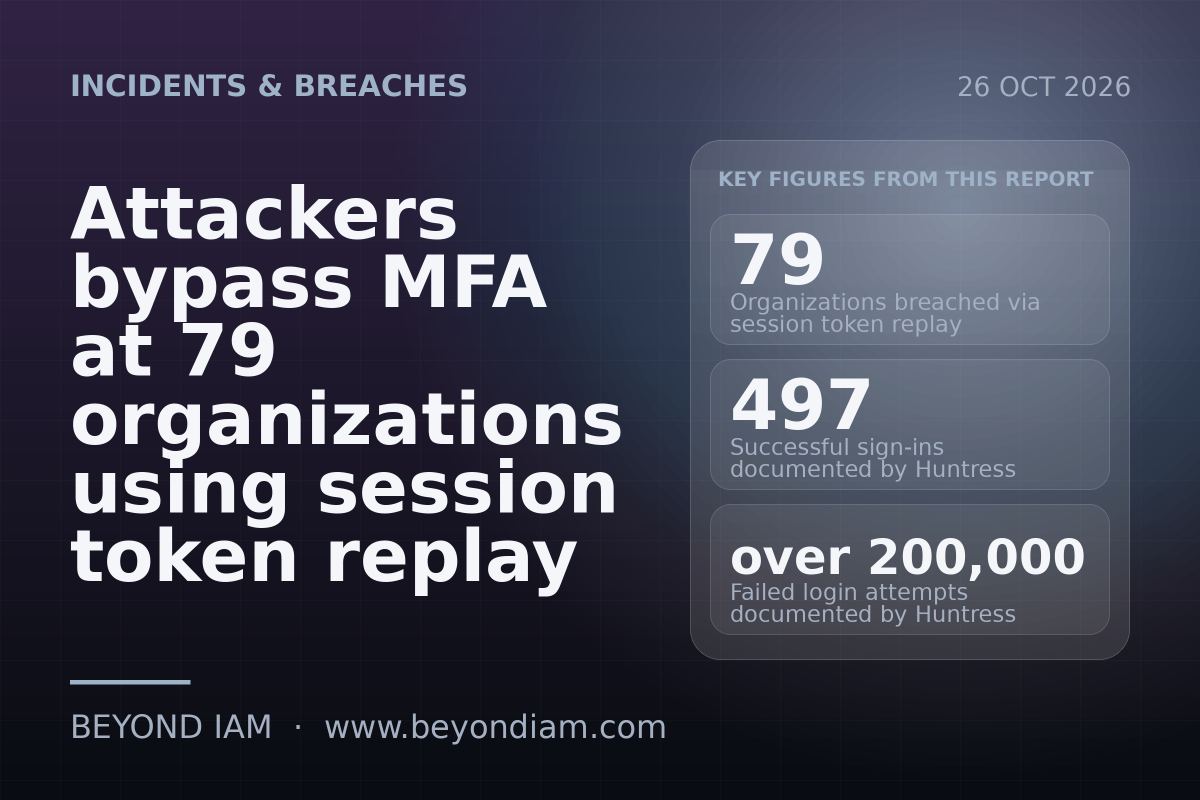
| Organizations breached via session token replay | 79 |
|---|---|
| Successful sign-ins documented by Huntress | 497 |
| Failed login attempts documented by Huntress | over 200,000 |
| Rogue computers registered in Microsoft Entra directories | at least 48 |
| IT and security professionals surveyed by Semperis | 1,200 |
Attackers breached Microsoft 365 accounts at 79 organizations between July and September 2026 by replaying stolen session tokens to bypass multi-factor authentication (MFA) [3].
Threat actors can circumvent MFA by capturing tokens issued after the authentication process is complete. This shift toward identity-based attacks aligns with a trend where identity systems—cloud-based identity and access management services used for securing user authentication and resource access [1]—are primary targets for ransomware operators.
Token replay breaches 79 organizations
Between July 14 and September 22, 2026, an attacker compromised email accounts at 79 organizations using stolen sign-in sessions [3]. Researchers from Huntress documented 497 successful sign-ins and over 200,000 failed login attempts [3].
The attacker used adversary-in-the-middle (AiTM) relays to capture session tokens [3]. These relays pass genuine Microsoft login pages and MFA prompts to the victim; once the victim completes the process, the relay captures the resulting session token [3]. Because the token is issued after MFA verification, the attacker can access the account without a password or further MFA [3].
Attackers also obtained tokens through social engineering during ordinary logins and via device-code phishing, where victims entered codes on legitimate Microsoft sign-in pages [3]. Huntress researchers noted, "The Microsoft accounts were compromised without the attacker ever needing a password" [3].
Campaign infrastructure and persistence
The attacker used servers from 1337 Services GmbH, a Hamburg-based hosting provider [3]. The researchers termed the bulk replay of stolen sessions "token spraying," describing it as the same pattern as password spraying but using tokens instead of guessed passwords [3].
Activity was highly time-sensitive. On July 21, a hijacked session appeared from a 1337 Services address 12 minutes after the victim reached the MFA prompt; by September 22, that gap dropped to four minutes [3]. The attacker cycled through six addresses in the 193.26.115.0/24 range across four phases [3].
To maintain access after sessions expired, the attacker registered at least 48 rogue computers in Microsoft Entra directories [3]. These devices were named “DESKTOP-” followed by eight hexadecimal characters [3]. In 19 organizations, the attacker deleted existing MFA methods and registered a new one within three hours of the initial sign-in [3].
In one instance, an authenticator app labeled “iPhone 13” was activated less than an hour after the session was hijacked [3]. This allows attackers to complete MFA for new sign-ins at will, a state that persists after a password reset [3].
Inside accounts, the attacker used hidden inbox rules named “.”, “sss” and “iT” to delete or move mail to folders like Conversation History and RSS Feeds [3]. In one case, the attacker targeted payroll emails containing "bonus," "bank," "direct deposit," or "payroll," and hid all mail from the victim's external accountant [3].
Identity systems as ransomware targets
The Semperis 2026 Ransomware Risk Report surveyed 1,200 IT and security professionals across nine countries and eight industry sectors [5]. The report found that 87% of ransomware cases involved targeting or exploiting identity systems [5]. All surveyed organizations had experienced at least one successful ransomware attack that disrupted operations [5].
Entra ID was targeted in 48% of attacks, Active Directory in 51%, and Okta in 27% [5]. These categories overlap [5]. Tomer Bar, a security research executive at Semperis, warned that "attackers with suitable permissions can use Active Directory to move between machines and encrypt systems" [5].
Recovery gaps persist: only 50% of surveyed organizations maintained dedicated identity backups, and 42% used automated identity recovery solutions [5]. Documented recovery procedures existed for Active Directory at 60%, Entra ID at 52%, and Okta at 28% [5].
Among surveyed victims, 69% suffered multiple successful ransomware attacks within a single year [5]. Forty percent of respondents reported AI-based attacks, while 44% reported attacks exploiting their own AI agents or systems [5].
Microsoft guidance on service accounts
Microsoft provides guidance on creating service accounts in Entra ID that are exempt from MFA [1].
These exemptions are for non-interactive purposes, such as automated services that cannot respond to MFA prompts [1]. This is necessary because current Conditional Access (CA) policies and mandatory MFA enforcement typically prompt for credentials and MFA when accessing SSO-integrated applications [1].
What we don't know
- What specific security controls failed at the 79 organizations to allow the AiTM relays to succeed?
- How many of the 79 organizations detected the rogue devices registered in their directories?
- What specific "AI-based attacks" are described in the Semperis report?
Sources
- Creating Service Accounts in Entra ID to Bypass MFA for Non-Interactive ... — learn.microsoft.com, Oct 25, 2026
- Microsoft 365 accounts compromised at 79 organizations, no passwords needed - Help Net Security — helpnetsecurity.com
- 87% of Ransomware Attacks Target Active Directory, Entra ID and Okta — cyberpress.org
Photos and video from the reports
Further reading
- How to Detect and Stop Session Hijacking: 12 Steps
A guide providing 12 steps to detect and stop session hijacking and cookie theft across Entra ID and Okta.