

US agencies warn of global cyberattacks targeting industrial refrigeration
US agencies warn that hackers are exploiting internet-exposed refrigeration controllers to trigger defrost cycles, risking food spoilage and fire hazards across global supply chains.
Key figures
| French supermarkets affected (estimated) | 250 to 350 |
|---|---|
| French supermarkets affected (Finance Minister) | approximately 700 |
| Total French supermarkets | 10,000 |
| Peak unit temperatures | 50°C |
| Stores affected in second wave | over 115 |
Timeline
- Hackers compromise refrigeration controllers at French supermarkets
- French Blood Establishment confirms cyber incident at three blood storage facilities
- US federal agencies issue joint advisory on industrial refrigeration cyberattacks
US federal agencies issued a joint advisory on November 5, 2026, warning of global cyberattacks targeting industrial refrigeration and cold chain monitoring systems [1]. These attacks can cause widespread inventory loss, equipment damage, and physical fire hazards [1][2].
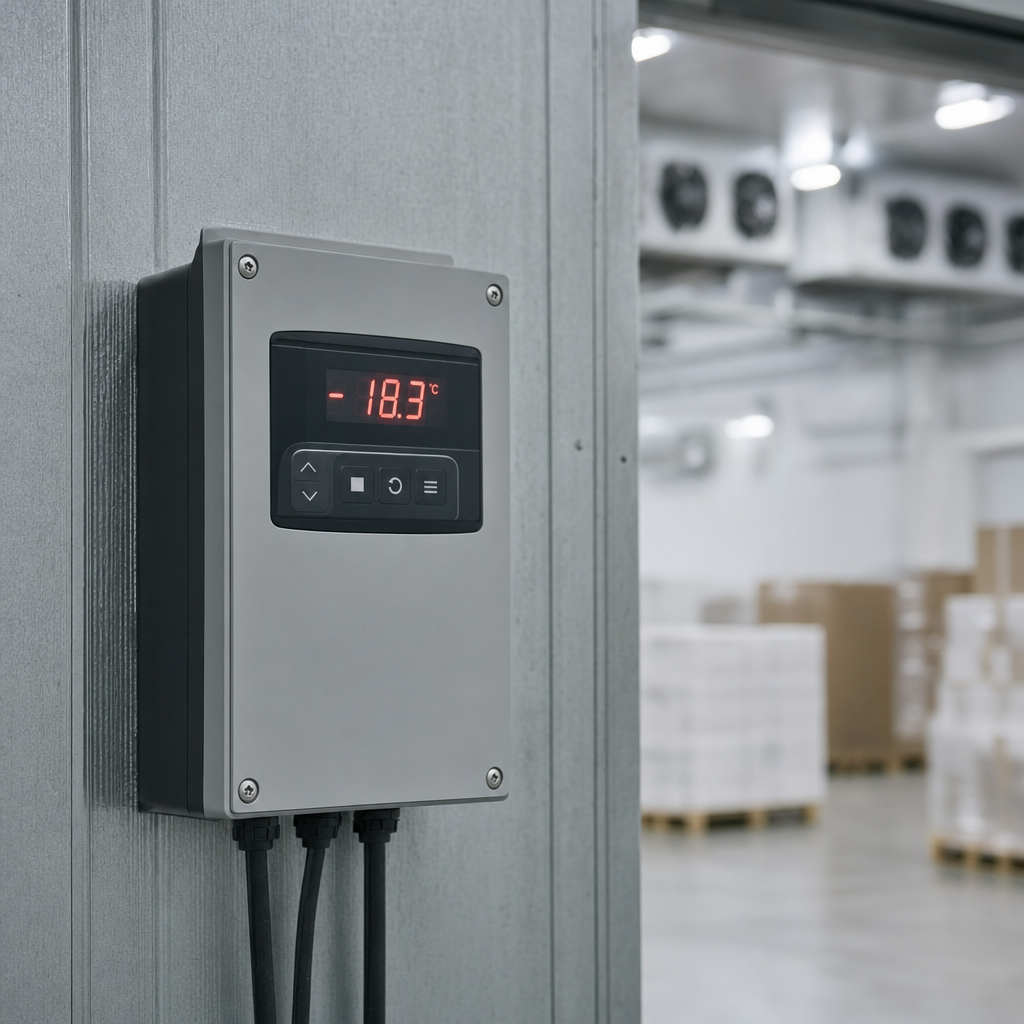
The threat targets operational technology where aging controllers are often exposed to the public internet [3]. These systems manage temperature logging, defrost cycles, and energy optimization for the healthcare, food, chemical, and transportation sectors [1].
US Federal Warning on Refrigeration Security
CISA, the FBI, and the departments of Health and Human Services, Agriculture, and Transportation issued the warning [1]. The agencies report that malicious actors are targeting electronic temperature controllers and commercial refrigeration management systems in retail grocery and cold storage facilities [1].
The agencies say attackers may exploit weak configurations, authentication bypass vulnerabilities, arbitrary code injection flaws, or unpatched, internet-accessible controllers to remotely alter settings [1][2]. By forcing units into continuous heating or defrost cycles, actors can create unsafe storage conditions and reduce equipment lifespan [1][2].
CISA's Acting Executive Assistant Director for Cybersecurity, Chris Butera, said, "Every organization that depends on refrigeration and monitoring systems should assume it could be a target" [2].
Disruptions in European Retail and Healthcare
The warning follows attacks in Europe that disrupted blood storage and supermarkets [2]. Between October 11 and 12, 2026, hackers compromised refrigeration controllers at an estimated 250 to 350 French supermarkets [2][3].
France's finance minister, Roland Lescure, told Parliament that approximately 700 of the country's 10,000 supermarkets were affected [3]. During these attacks, defrost cycles were extended from one hour to eight hours [3]. Temperatures in some units climbed to 50°C and stayed high for six hours [2][3].
The disruptions affected retailers including Carrefour, Monoprix, E.Leclerc, and Netto [3]. For Coopérative U, TIME reported at least 100 affected stores, while other reports state approximately 80 [3].
A second wave in November affected more than 115 stores across six European countries [2]. On November 3, the French Blood Establishment (EFS) confirmed a cyber incident involving a refrigeration equipment provider altered settings at three facilities used to store blood products [2].
CERT-FR issued a bulletin naming the affected equipment as Danfoss AK-SM and AK-SC series controllers, as well as Copeland XWEB and Dixell XWEB monitoring systems [3]. Danfoss identified its AK-SM800 and AK-SC355 systems as notably affected [3].
Claroty identified vulnerabilities in the AK-SM 800A in August 2026, finding numerous Danfoss controllers were directly accessible from the public internet [3]. A Claroty researcher, identified only as Utzke, stated an attacker reaching an exposed AK-SM 800A platform could “execute arbitrary operating system commands” [3].
Investigation into US Military Base Malfunctions
The global trend extends to US government infrastructure [6]. The Pentagon is investigating a series of mysterious malfunctions that hit grocery store refrigeration units on US military bases in August [6].
Reuters first reported that investigators are treating these malfunctions as cyberattacks [6]. These incidents align with broader observations of operational technology exposure [7].
Warning to Critical Infrastructure
The FBI, CISA, and the departments of health, transport, and agriculture issued a joint statement warning of an "ongoing cyber threat" to industrial refrigeration systems [6]. The agencies stated that "malicious cyber actors" are targeting vulnerabilities in internet-accessible controllers in retail grocery and cold storage facilities [6].
FBI Cyber Branch Operations Director Brett Leatherman said the government is "seeing these systems targeted across critical infrastructure sectors globally" [6].
The statement warned that successful exploits could change temperatures and cause "physical impacts such as fire hazards, loss of inventory and changes to the service life of the system" [6]. CISA acting executive assistant director for cybersecurity Chris Butera said every organization depending on these systems "should assume it could be a target" [6].
What we don't know
- Which specific vulnerability was exploited to trigger the French supermarket attacks?
- Have any individuals or groups officially claimed responsibility for the European retail hacks?
- How many US-based commercial facilities have already been compromised beyond the military bases?
Sources
- [1] US Government Partners Urge Hardening Industrial Refrigeration and Cold Chain Monitoring Systems — CISA advisories, Nov 5, 2026
- [2] FBI, CISA warn of cyberattacks targeting refrigeration systems — bleepingcomputer.com
- [3] France Fridge Hack: 4 Systems Risk US Grocers — shattered.io
- [6] U.S. warns of 'ongoing cyber threat' to industrial refrigeration systems — cnbc.com
- [7] A new cold war: hackers target fridges across the globe — wuky.org
Photos and video from the reports
- Video: A digital controller for an industrial refrigeration system showing a high temperature warning.
- Video: A video reporting on cyberattacks targeting French supermarkets.
- Photo: A woman walks past empty fresh-food refrigerators at an Intermarché supermarket in France.
- Photo: A technician monitors industrial refrigeration controls in a supermarket.